Replying with Action Components
The ConfigurableReply
object is also used to attach components. You reference action components by the name of the method they are defined with, just
like we did before with modals.
Example
@Command("greet")
public void onCommand(CommandEvent event) {
    event.with().components("onButton").reply("Hello World!"); //(1)!
}

@Button("Greet me!")
public void onButton(ButtonEvent event) {
    event.reply("Hello %s".formatted(event.getUser().getAsMention()));
}
- We reference the Button we want to send via the method name.
You can also omit the text message and only send the component by calling reply() with no arguments.
Action Rows
Every call to components() will create a new action row. If you want more than one action row you need to call
components() multiple times.
If you want to add multiple action components to the same action row, just pass the method names to the same components() call.
Note
One action row supports up to 5 buttons but only 1 select menu.
Enabling & Disabling
By default, all action components are enabled. If you want to attach a disabled action component, you need to wrap it by calling
Component#disabled(String, Entry...)
If you want to add multiple action components to the same action row, with some of them enabled and some disabled, you need to wrap all of them.
Example
Keeping Components
When working with components and especially when building menus, e.g. a pagination with buttons, it is often needed to keep the components attached, even when editing the original message multiple times.
Normally, Discord would remove any components when sending a message edit, unless they are explicitly reattached.
JDA-Commands flips this behavior and will keep your components attached by default.
You can disable this by calling keepComponents(false):
Alternatively you can call ComponentEvent#removeComponents() which will remove all action components attached to a message.
Note
When using Components V2 calling ComponentEvent#removeComponents() will throw an UnsupportedOperationException because this would result
in an empty message.
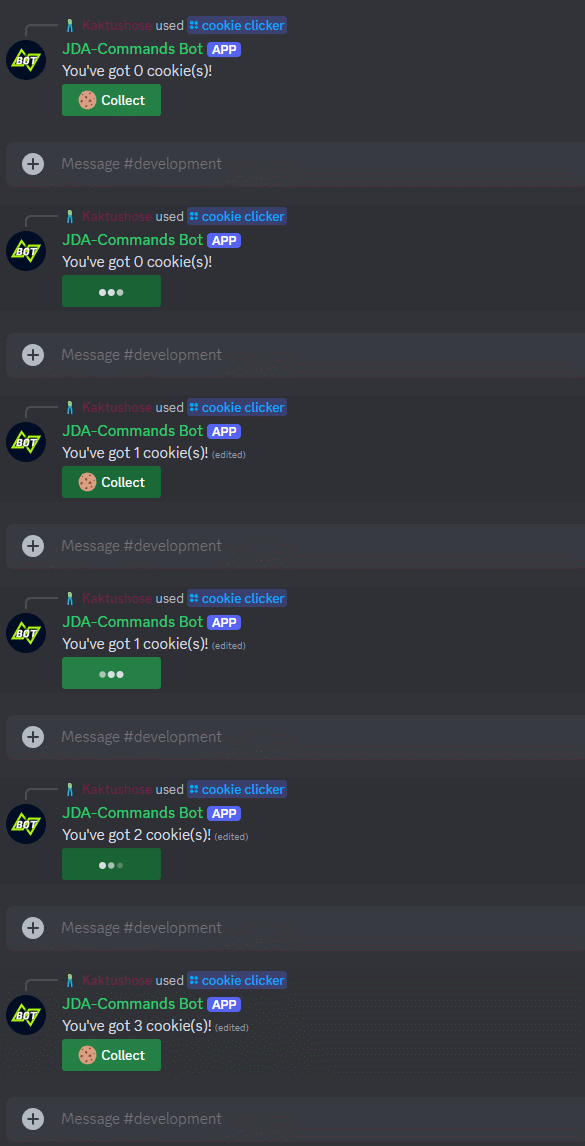
Cookie Clicker Example
@Interaction
public class CookieClicker {

    private int counter;

    @Command(value = "cookie clicker", desc = "Play cookie clicker")
    public void onClicker(CommandEvent event) {
        event.with().components("onCookie").reply("You've got { $count } cookie(s)!", entry("count", counter));
    }

    @Button(value = "Collect", emoji = "🍪", style = ButtonStyle.SUCCESS)
    public void onCookie(ComponentEvent event) {
        event.reply("You've got { $count } cookie(s)!", entry("count", counter++));
    }
}
Keeping Selections
By default, JDA-Commands will also retain the selections of select menus when sending a reply with keepComponents set
to true. You can disable this by calling keepSelections(false):
Foreign Components
You can attach action components that were defined in a different class by using the Component#enabled(Class, String, Entry...)
class again. In addition to the method name, you must also pass the class reference in that case.
Example
The foreign action component will use the original Runtime just like any other action component would. If no
instance of the class the action component is defined in (ButtonHelpers in the example above) exists yet,
the Runtime will create one instance (and store it for potential future method calls).
Lifetime
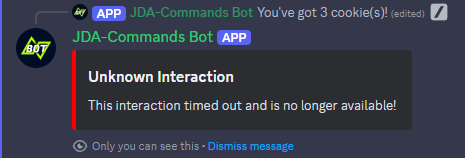
As discussed earlier, Runtimes have a limited lifetime. By default, JDA-Commands will close a Runtime after 15 minutes of no activity have passed.
Component Lifetime
This means all action components belonging to that Runtime will stop working once the Runtime is closed!
JDA-Commands will handle this case for you. This error message can be customized.
If you want to avoid this behavior, you have to reply with action components that are runtime-independent. They will create a
new Runtime everytime they are executed. These action components will even work after a full bot restart! If you want them to not be usable anymore you need to remove
them on your own.
Info
Modals cannot be independent because they always need a parent interaction that triggers them!
Dynamic Components
Just like with Modals, you can dynamically modify components too. Use the Component#enabled(Class, String, Entry...)
class to access a builder object, which wraps the JDA builder. Alternatively, you can access the native JDA builder by
calling #modify.